
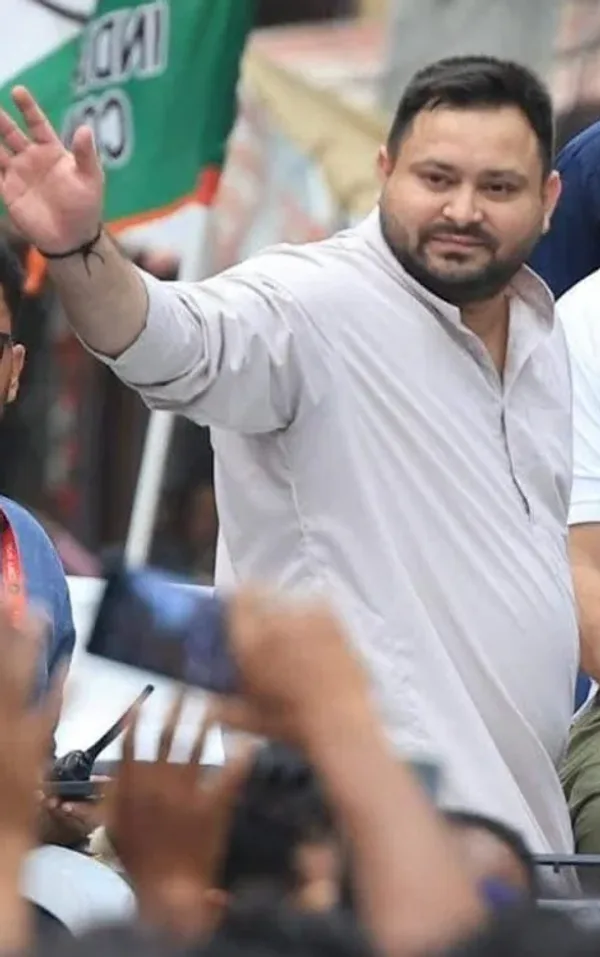
Biography & Career Overview
Tejashwi Prasad Yadav, born on 9 November 1989 in Gopalganj, Bihar, is the most recognisable face of the next generation of Yadav politics in India and the de facto leader of the Rashtriya Janata Dal (RJD) since March 2018. The youngest son of Lalu Prasad Yadav and Rabri Devi — both former Chief Ministers of Bihar — he has served twice as Deputy Chief Minister of Bihar, has been elected to the Bihar Legislative Assembly three times from the Raghopur constituency, and holds the distinction of having been, at various points, both the youngest Deputy Chief Minister in Bihar's history and the youngest Leader of the Opposition in India. He was a principal architect of the Mahagathbandhan (Grand Alliance) that swept the 2015 Bihar elections, the campaign driver who took the RJD to 75 seats as the single largest party in 2020, and — after the alliance's painful collapse to 35 seats in 2025 — remains his party's central figure. Featured in the Indian Express list of 100 Most Powerful Indians in 2020 and 2021, he occupies an unusual position in Indian politics: dynastic in origin, yet personally tested at the ballot box in three consecutive cycles with wildly different results.
Early Life and Education
Tejashwi is the youngest of nine children — with seven sisters and a brother, Tej Pratap Yadav — born into the household that has dominated Bihar's Yadav political narrative for three decades. His father Lalu Prasad Yadav, the charismatic and contentious former Railway Minister and Chief Minister, built his career on the social-justice platform of Mandal-era OBC assertion, and that ideology became the atmosphere of Tejashwi's childhood. The family kept a base in Delhi, and Tejashwi was schooled there: primary classes at Delhi Public School, Vasant Vihar up to Class V, then from Class VI at the prestigious Delhi Public School, R.K. Puram. He never finished Class X — he dropped out of school in the tenth grade to pursue a sports career, a decision that surprised Delhi's cricket circles far less than Bihar's political ones eventually would. His formal education therefore stops at the school level, a fact frequently thrown at him by critics, though he has campaigned and governed at the highest levels of state politics since his twenties.
Cricket Career
Before politics consumed his life, Tejashwi was a genuinely promising cricketer. A right-handed batting all-rounder, he was selected at age thirteen to the Delhi under-15 team — an under-15 side captained by a teenage Virat Kohli. That team won the national championship, and in the final Tejashwi shared a match-winning partnership with Ishant Sharma, the future India fast bowler. He progressed to Delhi's under-17 and under-19 teams and was named in the standby list of a World Cup-winning Indian under-19 national squad. In 2008 he was contracted by the Delhi Daredevils for the inaugural Indian Premier League season — one of the youngest names on the founding rosters — but he sat on the reserve bench through the 2008 to 2012 seasons without a league appearance. He then moved to state cricket with Jharkhand in 2009, debuting professionally in the Syed Mushtaq Ali Trophy as a bowler in four Twenty20 matches, followed by a first-class appearance against Vidarbha at Dhanbad. In 2010 he made his one-day debut in the Vijay Hazare Trophy, playing against Odisha and Tripura. Cricket remained a competitive apprenticeship rather than a breakthrough, and in 2013 he retired from the sport to commit fully to politics.
Entry into Politics and First Stint as Deputy Chief Minister
Tejashwi began his political life in 2010, campaigning for the RJD. He first contested a Bihar Legislative Assembly seat in 2015 from the Raghopur constituency in Vaishali district, part of the Mahagathbandhan of RJD, JD(U) and Congress that denied Narendra Modi's BJP a foothold in Bihar. The alliance swept the election, and Chief Minister Nitish Kumar inducted the 25-year-old Yadav into the fifth Nitish ministry; on taking office he became the state's youngest Deputy Chief Minister, holding charge of public works, forestry and environment. The experiment ended in 2017, when the CBI filed its IRCTC hotel-tender case against the Yadav family and Nitish Kumar took JD(U) out of the alliance to join the NDA, bringing the government down. Tejashwi declined to resign when asked, and the episode hardened his reputation as the combative wing of the family.
RJD Supremo, 2020 Campaign, and Second Deputy Chief Ministership
In March 2018, with his father Lalu Prasad Yadav convicted in the fodder scam and facing trial in the IRCTC case, Tejashwi became the de facto leader of the Rashtriya Janata Dal. He led the Mahagathbandhan as its chief ministerial candidate in the 2020 Bihar Assembly election, running an energetic, social-media-savvy campaign built on a promise of ten lakh government jobs for Bihar's youth, backed by caste-survey politics. The alliance won 110 of 243 seats — short of the 122 needed — with the RJD itself returning as the single largest party at 75. The BJP-led NDA retained power, and Tejashwi instead became Leader of the Opposition, the youngest in the country. His opportunity came in August 2022, when Nitish Kumar engineered a second Grand Alliance with RJD and Congress; on 10 August 2022 Tejashwi took oath again as Deputy Chief Minister, the kingmaker of a government that also, briefly, put an RJD member in the Raj Bhavan. That arrangement too ended in June 2024 when Nitish Kumar returned to the NDA, terminating Yadav's second tenure and pushing the RJD back into opposition. Over the ministry's 22 months he carried the Public Works Department portfolio alongside irrigation and river-development charges, was credited by the government with the 2023 Social Justice Survey — the caste census whose finding of a roughly 63 percent Other Backward and Extremely Backward population reset Bihar's political conversation — and launched the Mukhyamantri Nishulk Dava Yojana free-medicine scheme, the flagship he cited most often on the 2025 campaign trail.
2025 Bihar Election and Current Position
Tejashwi again led the Mahagathbandhan as its chief ministerial candidate into the 2025 Bihar Legislative Assembly election, campaigning on his record in office and against unemployment and economic distress. The result was the severe reverse of his career: the alliance managed just 35 seats of 243, with the RJD on 25 — its record low — as the NDA secured a sweeping mandate. Yadav retained his Raghopur seat for a third term as MLA and has continued as the principal opposition voice from the Bihar Legislative Assembly, demanding special category status for the state and accountability on jobs and migration. The defeat has triggered intense internal debate about RJD's strategy and family leadership, but no credible challenger within the party has displaced him. Analysts attributed the scale of the reverse partly to voter fatigue with duel-of-dynasties politics and to the NDA's consolidation around development and law-and-order messaging; yet the campaign itself — marathon rallies, a heavy social-media operation, and youth-focused promises — re-established Tejashwi, at 35, as the most prominent statewide campaigner the RJD has ever fielded, a position no rival within the party's ranks currently threatens.
Legal Cases and Controversies
Tejashwi's 2020 election affidavit disclosed 11 pending criminal cases. The most consequential is the IRCTC hotel-tender case filed by the CBI in 2017 against Lalu Prasad Yadav, Rabri Devi and Tejashwi, alleging that contracts to maintain IRCTC hotels in Ranchi and Puri were awarded to a private firm in exchange for prime Patna land transferred at a fraction of its value to a shell company, 'Sujata Hotel', controlled by the family; he is named under IPC sections 120B and 420 and anti-corruption law, was granted bail in 2018, and the case remains under trial in a Delhi court. In 2022 the CBI registered the land-for-jobs case, alleging the family took plots in return for Group D railway jobs during Lalu's Railway Ministry years, with the Enforcement Directorate attaching properties and questioning Tejashwi in a parallel money-laundering probe; a 2023 charge sheet names him, and courts are hearing arguments on framing charges. In October 2020, former RJD leader Shakti Malik was shot dead in Purnia district; his family's FIR accused Tejashwi and Tej Pratap of the killing after a viral video in which Malik alleged a ₹50-lakh donation demand for a party ticket. Separately, his 2024 remark that "only Gujaratis can be thugs" — a jibe at economic offenders — drew a criminal defamation complaint; he withdrew the statement in court, and the Supreme Court quashed the proceedings in February 2024.
Personal Life and Legacy
On 9 December 2021, Tejashwi married his long-time friend Rachel Godinho, a Goan Catholic from Rewari, Haryana, who had grown up in Delhi and studied with him at DPS R.K. Puram; after the wedding she adopted the name Rajshree Yadav. The marriage was itself a political statement of quiet social reach beyond Yadav heartland calculations. Tejashwi Yadav's career so far reads as a three-decade dynasty's attempt to convert itself into a modern, youth-facing political brand — spectacularly successful in 2015 and 2020, chastened in 2025, and unmistakably still the central figure of Bihar politics whom most observers expect to contest for the chief ministership again.
His Place in the Yadav Story: Context, Cross-Links and Sources
Tejashwi Yadav's career poses, in its sharpest form, the central question of Yadav politics in the twenty-first century: what happens when community strength meets an electorate that keeps changing its mind. He entered the assembly as a 26-year-old, became deputy chief minister before thirty, rebuilt the RJD's campaign machinery as a floor-adjacent ringmaster, and then watched the 2025 election test whether a family name and a welfare promise — the INDIA bloc's vaunted youth-and-benefits pitch — could hold against a rival social stack. That he remains, in every serious reading, the opposition's most consequential figure in Bihar is the point: dynastic inheritance has been metabolised, however unevenly, into a personal political asset.
This profile is part of YadavNews.in's effort to document high-achieving members of the Yadav community with named sources and dates rather than rumour. Readers who want the deeper background will find it in our fact-checked long read on the origins of the Yadav community, which keeps the social history separate from the party arithmetic, while the verified guide to notable Yadav personalities maps everyone we follow across politics, cricket and entertainment. The natural companion piece in this archive is the biography of Akhilesh Yadav, the Uttar Pradesh counterpart whose Mandal-heir trajectory parallels Tejashwi's from a different state, party and generation of the same political world; both sit in the politicians section of the site.
Offices held, election results, margins and assembly tenures in this article are taken from Election Commission of India records and official government gazettes; the Patna port and industrial-project descriptions follow budget documents and assembly proceedings rather than press paraphrase, and each reference in the panel carries its verification date. Where outside accounts conflict with ours, our corrections policy sets out how we investigate and amend. For a continuously-updated third-party summary, the Tejashwi Yadav profile on Wikipedia serves as a cross-check, though our working record is maintained against the primary documents.
Reading the Record
The same caution that shapes this profile should shape how readers use it. An opposition leader's influence is easiest to measure on election night and hardest to measure in between, so the biography above leans on verifiable anchors — seats won, margins, ministries held, budgets passed — and treats commentary about 'inevitability' or 'decline' as exactly that: commentary. Bihar's politics moves faster than any archive can track, which is why this page carries a verification date in its header rather than pretending to be current forever. Where the public record is genuinely contested — the sequencing of alliance talks, the authorship of a policy, the status of a case — the article names the competing accounts instead of choosing one silently. Readers following the broader story of how Yadav political families rose with Mandal social politics can place Tejashwi's Bihar chapter inside that larger arc through our history feature on the origins of the Yadav community, which deliberately stops short of present-day partisanship.

